How AI Is Changing Print Marketing for Businesses
It hasn’t taken long for AI to find its way into everyday marketing.
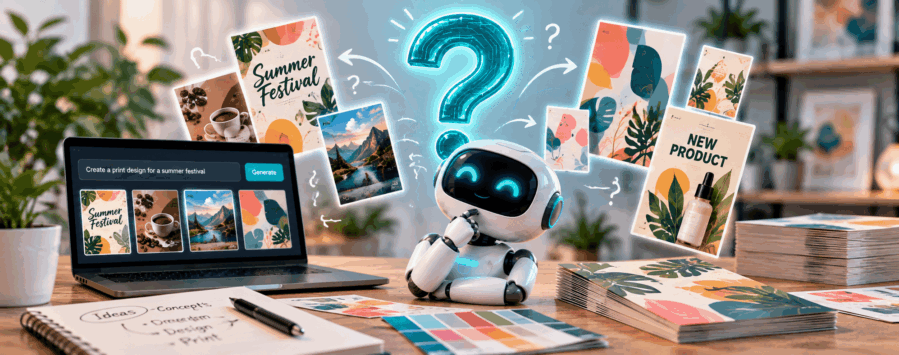
A few years ago, coming up with campaign imagery usually meant working with a designer, booking photography or searching through stock libraries. Today, a rough idea and a decent prompt can be enough to start seeing different creative directions almost immediately.
That doesn’t mean designers are disappearing or every campaign is suddenly being created by a machine. What has changed is where a lot of projects begin.
We’re seeing more customers come to print with concepts, illustrations and imagery they’ve already started creating themselves. Sometimes it’s just an early idea they want to develop further. In other cases, much of the artwork is already there and simply needs preparing properly before it can become a printed product.
For businesses, particularly smaller ones, that gives them far more room to explore.
Ideas can take shape much earlier
Trying several creative directions used to involve quite a lot of time before you could even decide which one you liked.
That first stage can now happen much faster.
A restaurant planning a seasonal menu could try a completely different visual style before committing to it. An events company might compare several poster concepts. A retailer launching a new product could experiment with backgrounds, illustrations or campaign themes before deciding what actually fits.
None of that automatically makes the finished result ready for print, of course.
What it does give businesses is a better chance to explore an idea before money is spent producing it.
There’s also less pressure to settle on the first thing that looks reasonable. A bold illustrated concept can be compared with something cleaner and more photographic. Seasonal versions can be tried. The same message can be seen in several different styles.
Print itself hasn’t suddenly become editable after it’s produced. Once 5,000 leaflets have been printed, you can’t change the image with a click.
The experimentation simply happens earlier.
And that can make the final decision a much better-informed one.
Creating more doesn’t always mean creating better
Making artwork has become much more accessible, which is one of the genuinely useful things about AI.
A small business doesn’t necessarily need a large creative budget just to see whether an idea has potential.
The other side of that is how easy it is for something to look finished before it actually is.
An image might look fantastic at the size it appears on a laptop. Enlarge it for a poster and the detail may not hold up quite so well.
Text can be misspelt or distorted. A logo might have been recreated instead of using the proper artwork. Colours that look particularly bright on screen may feel very different when they’re printed onto paper.
Those problems aren’t impossible to deal with, but spotting them before production is a lot easier than spotting them afterwards.
We’ve gone much deeper into that side of things in our AI Artwork, Print & Design Help Centre, covering everything from image quality and colour setup to AI-generated text and preparing files for print.
For the wider marketing picture, the main thing is simply knowing that generating the artwork is only part of the job.
Your brand still needs to look like your brand
One of AI’s strengths is how quickly it can produce variation.
Ask for another version and you can often have one in seconds.
Used well, that gives businesses plenty of creative freedom. Used without much direction, it can also make everything start to feel slightly disconnected.
Perhaps the brochure has one style of illustration, the social campaign uses something completely different and the next menu goes in another direction again.
Look at each piece on its own and there may be nothing wrong with it.
Put everything together and it might be harder to tell that it all came from the same business.
Things like your proper logo files, brand colours and typefaces become even more important when creating content gets easier. It also helps to know what your business should actually feel like. Playful? Minimal? Traditional? Bold?
There’s plenty of room for new imagery around that, but your identity shouldn’t have to be reinvented every time somebody writes a new prompt.
The strongest use of AI is probably going to be within brands that already know who they are.
Then the design has to leave the screen
This is the part that makes print different.
Eventually, the artwork becomes something physical.
Someone picks up the menu, flicks through the brochure or sees the poster from the other side of a room.
A business card has to work in somebody’s hand. A sticker has to make sense once it’s attached to the packaging. A leaflet may only have a few seconds to get somebody’s attention.
That changes what makes a design successful.
Very detailed imagery that looks great online can become too busy once it’s squeezed onto a smaller format. Decorative text that works in a mock-up might be difficult to read at its actual printed size. Dark artwork can look dramatic on a bright screen and much heavier once ink hits paper.
None of these are particularly new print problems. We’ve been thinking about them for years.
What’s changing is that more people can now create the artwork themselves before they’ve necessarily had a reason to think about how the finished piece will behave.
An A1 poster isn’t simply a bigger business card. A menu that gets handled every day needs to be considered differently from a leaflet being handed out once. A 60-page brochure comes with different decisions to a single printed sheet.
However the image was created, the finished product still has to do its job.
Campaigns could become much more flexible
Another area worth watching is personalisation.
That doesn’t necessarily mean producing a completely unique piece of print for every customer. More realistically, it could mean creating more versions of the same campaign without each one becoming a major design project.
A hotel group might adapt its imagery for different locations while keeping everything within the same visual style.
Restaurants could change creative for seasonal menus and promotions.
An events company might use slightly different poster artwork depending on the audience or venue.
Businesses have always been able to do this. The difference is how much creative time can be involved in producing every variation.
If that part becomes easier, there may be more reason to think about whether one piece of artwork really needs to do everything.
Quantities, production costs and distribution still have to make sense, but the creative side becomes less of a barrier.
Good judgement still counts for a lot
Having more options is useful. Knowing which one to choose is arguably even more useful.
A generated image doesn’t know that a brochure is going to sit on a reception desk for the next six months.
It doesn’t know that a menu will be picked up hundreds of times.
And it doesn’t know that someone viewing a poster may be walking past it rather than sitting directly in front of a screen.
Those decisions still need somebody who understands the business, the audience and what the finished marketing needs to achieve.
Sometimes that means choosing one concept over another.
Sometimes it means simplifying something.
And occasionally it means deciding that the clever-looking image AI produced simply isn’t right for the job.
What does all this mean for print marketing?
The route from idea to finished print is changing, but the purpose of the finished product really isn’t.
Businesses can try more ideas. Small teams have access to creative tools that would once have felt out of reach. Marketing departments can move from a rough concept to something visual much faster.
But the final piece still needs to look right for the business, be easy to understand and work properly at the size it’s being produced.
Most importantly, it has to make sense to the person who eventually picks it up, reads it or sees it across the room.
AI is making the beginning of the process much quicker.
What happens between that first idea and the finished piece of print is still where many of the important decisions are made.